In managing our projects, one of the topics we discuss most often in our business growth club is the Kanban method. Kanban is an agile methodology, similar to Scrum, that enables companies to continuously improve their efficiency and collaboration.
In this article, we'll explore in depth how Kanban works, break down its advantages and benefits, and talk about the Kanban board — so you can optimize your workflow and implement this powerful tool in your own company.
What is Kanban in a nutshell?
Definition of Kanban
The Kanban method is a system for managing workflow and improving its efficiency. It was developed by Toyota in the 1950s and has been gaining popularity in recent years as a way to manage work items and improve productivity.
The Kanban method uses a Kanban board to visualize the workflow and track progress. Kanban cards are used to represent work items, and the board is used to track the status of each card. Work in progress (WIP) is limited so that each item gets the attention it needs, which helps avoid bottlenecks and ensures work is completed efficiently.
Kanban is a flexible system that can be adapted to the needs of any organization and is becoming increasingly popular as a methodology for managing workflow and improving productivity.
How does the Kanban methodology work?
Kanban is based on the principle of visualizing work so that team members can see what needs to be done and when. It uses a board with cards representing different tasks. The board is divided into sections for the different parts of the workflow, and team members move the cards as they complete tasks. There is also a limit on the number of tasks that can be in progress at any given time, which streamlines many processes.
The key principles of Kanban are visualization, WIP limiting, and workflow management.
What is a Kanban Board?
A Kanban board is a tool that helps you visualize your work, track progress, and limit work in progress (WIP). Kanban boards can be used for any type of work, but are especially popular in software development.
Kanban boards consist of columns and rows, where each column represents a stage in the workflow and each row represents a task. Tasks are represented by cards, which contain information about the task — such as who is responsible, what it involves, and how much work remains.
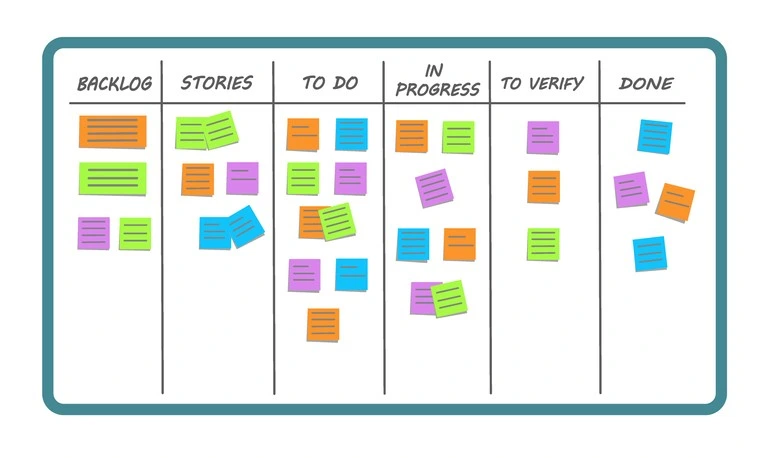
Cards move from left to right as they progress through the workflow stages. The number of cards in each column is limited, so only a certain amount of work in progress is allowed at each stage. This helps prevent workers from being overwhelmed with too much work and ensures tasks are completed on time.
There are many Kanban tools, both free and paid — some popular ones are Trello, Jira, and Asana.
Is Kanban an agile methodology?
Kanban is an agile methodology often used in agile development. It's a flexible approach that can easily adapt to different project needs, helping teams move quickly and deliver quality products.
Successful examples of the Kanban methodology
From manufacturing to software development, project management and beyond, the Kanban methodology has transformed how organizations approach work and manage their process flows. There are many success stories of the Kanban method across various industries and contexts. Here are some of the most notable.
Kanban and Toyota
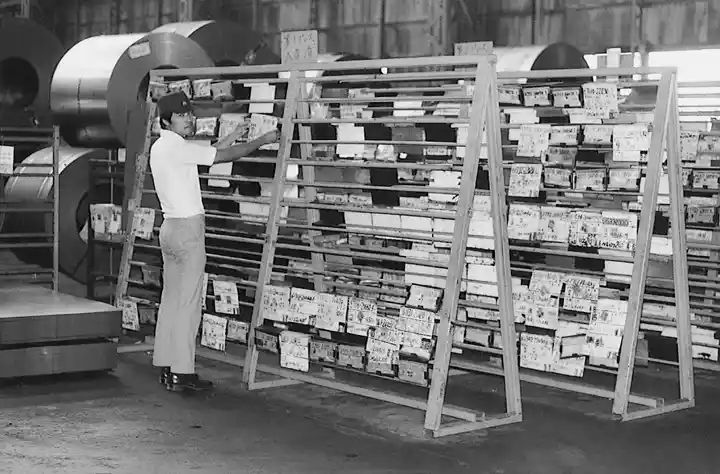
This is perhaps the most iconic example of Kanban's success. Toyota Motor Corporation implemented this system in the 1950s to improve efficiency and reduce waste in its manufacturing operations. The Kanban method allowed them to synchronize demand with production, reducing inventory and associated costs. Through Kanban cards, signals were sent when more parts or components were needed, ensuring each production stage had exactly what it needed at exactly the right time. This system not only helped Toyota become one of the world leaders in the automotive industry, but also laid the groundwork for Kanban's adoption in other industries.
Valve Corporation
Software development company Valve Corporation is another great example of successful Kanban application. Valve, known for popular titles like "Half-Life" and "Portal" as well as the Steam game distribution platform, has used Kanban to improve and streamline its software development process. By adopting a Kanban approach, Valve was able to identify bottlenecks, prioritize tasks, and ensure a consistent flow of work — resulting in faster, higher-quality software releases.
Spotify
The popular music streaming platform Spotify has also incorporated Kanban principles into its development teams. With teams called "squads", Spotify uses Kanban boards to visualize work from idea to implementation. This gives them a clear view of tasks in progress, pending, and completed. Thanks to Kanban, Spotify has improved cross-team collaboration, accelerated the time to launch new features, and maintained a high level of service quality.
If you're interested in learning more about Spotify, I invite you to also read my article on Spotify's most famous marketing strategy.
These examples demonstrate the versatility and effectiveness of the Kanban method, which can be applied across a variety of contexts — from automobile manufacturing to software development and streaming services.
What are the benefits and advantages of Kanban?
A Kanban work team can be very beneficial, as it can help limit the amount of work to be done at any given time. This helps keep the production process more organized and efficient, improving communication and collaboration within a team.
Is Kanban the same as Scrum?
Scrum and Kanban are two project management frameworks that can be used to improve productivity and communication in software development projects. However, there are some key differences between the two approaches:
- Scrum is a work management framework that is based on iterative cycles, or sprints. Each sprint typically lasts two weeks, and during that time the team works to complete a set of tasks. At the end of each sprint, the team reviews its progress and plans the next sprint.
- Kanban is a work management framework that is based on flow. That is, tasks are completed as they arrive, without being assigned to specific sprints. This can help teams be more flexible and responsive to change.
So while Kanban and Scrum can both be effective ways to manage software development projects, they have different approaches and may be better suited for different types of projects.
How to implement the Kanban method in your company?
Any company can apply Kanban if it wants to improve project management and streamline workflow.
To implement Kanban, you need to create Kanban cards for each task or project. These cards can be physical or digital, and should be placed in a visible location (like a whiteboard). Each card should contain the following information:
- The name of the task or project
- A brief description
- The status of the task or project (e.g., in progress, completed, blocked)
- The assigned team members
Once you've created the Kanban cards, you'll need to limit the number of tasks or projects in progress at any given time — this will help prevent team members from being overloaded and ensure tasks are completed in a timely manner.
The Kanban method is a great way to improve project management and optimize workflow in your company. By creating Kanban cards and limiting work in progress, you can ensure tasks are completed efficiently and effectively.
To close, I'd like to remind you of the opportunity to join my business growth club. There, you can discuss not only Kanban, but also a wide range of topics related to optimizing and growing your business. Sharing your experiences and learning from others can be an invaluable resource for developing your strategies and reaching your goals.
Also, if you feel the need to review your company's workflow and implement the Kanban methodology in a personalized way, I'm at your disposal. I offer a coaching service where, among other things, we study the Kanban method together and how it can be adapted to your specific situation.
Let's go!
Fabri