The empathy map is one of the best tools a company can use to understand its customers or potential customers. An empathy map helps you uncover thoughts, feelings, and behaviors by analyzing 6 aspects related to human experience.
To create an empathy map you'll only need a template and a guide — which I provide in this blog post — along with a pen and paper. After completing your empathy map step by step, you'll find you have a much deeper understanding of your customers, which will improve your relationship with them and the service you provide.
Let's start with:
- What is an empathy map?
- What is it used for?
- How to create an empathy map? + Template.
- Example of an empathy map
- How to use an empathy map
- The benefits of using an empathy map
- Empathy map vs buyer persona — what's the difference?
If you don't have time to read the full post right now, don't miss my video on my YouTube channel where you can cover all these points more quickly whenever you're ready.
Don't forget to subscribe! :)
What is an empathy map?
An empathy map is a visual tool used to gather and understand the thoughts, feelings, and behaviors of our users. It was first created by Scott Matthews at the agency Xplane, but gained wide popularity through Dave Gray's book Game Storming in 2010.
At its core, an empathy map is a simple diagram that describes the four central elements of empathy: thoughts, feelings, needs, and behaviors. By understanding the needs and perspectives of a person or group, companies can make more concrete decisions around product development, marketing, customer service, and more.
What is an empathy map used for?
This powerful tool is used in customer research, product design, and user experience design. As its name implies, it's a powerful tool for developing empathy with the user and creating better experiences.
By mapping four areas (thoughts, feelings, needs, and behaviors), teams can develop a better understanding of their users' motivations, attitudes, and goals.
How to create an empathy map? The template.
Creating an empathy map is a very simple step — it takes little time and it's worth it because it helps you connect better with your customers. To begin, you need to fill in the template below in the correct order (says, thinks, does, feels) and answer the corresponding questions in each section of the map.
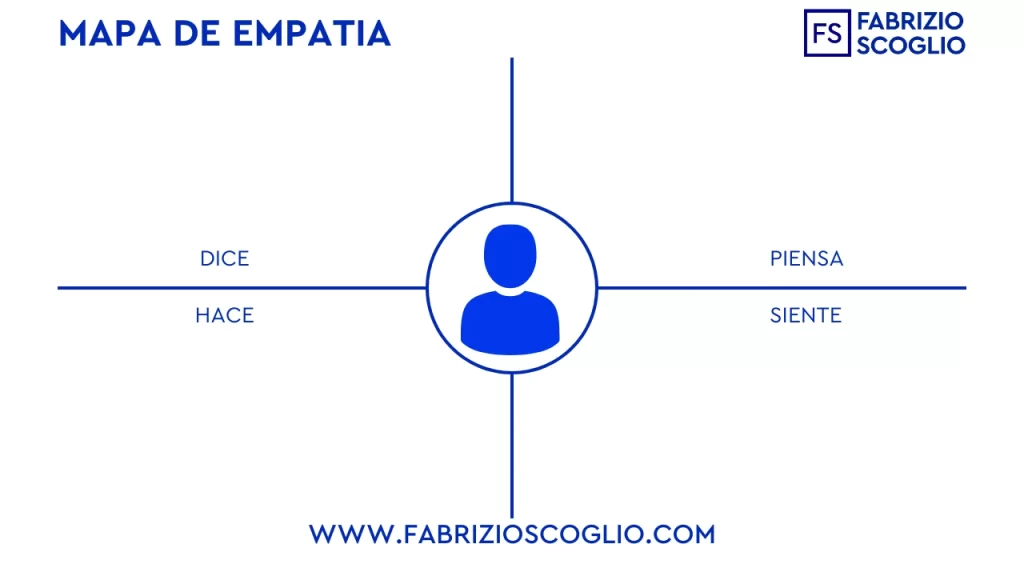
What they say
This is the first quadrant to complete. The goal of this quadrant is to understand what the person/customer says about our product or service — what idea they have of it. To do this, answer questions like:
- What would they tell us in an interview?
- What phrases do they use often?
- Are there words we need to know?
This is also very useful for your company's communication and marketing.
What they think
Next, we focus on the user's mindset with the goal of better understanding what the person thinks. To discover how or what they think, answer questions like:
- What are their hopes and goals?
- What do they believe in?
- What do they fear?
- What are their opinions about your product or service?
What they do
Third, consider the user's behaviors. This helps you understand the person's common activities. Questions like:
- How do they interact with your product or service?
- When they face the problem you want to solve for them, what do they usually do?
What they feel
Finally, consider their feelings. This lets you uncover deeper emotions and understand what to do to encourage a purchase. Questions like:
- What are their concerns?
- What stops them from buying?
How to use an empathy map.
Here are some of the different ways you can use an empathy map. Depending on what you want to discover about your customers, you can use the empathy map in different ways:
- To understand people's needs and pain points. By knowing what people think, feel, do, need, and say, you can better understand what they really want and need from your product or service.
- To develop empathy. The map can help you develop a deeper understanding of their needs and create products and services that serve them better.
- To brainstorm innovative solutions. An empathy map can be used to generate ideas based on the information you've gathered, leading to innovative solutions.
- To identify user segments. The map also allows you to segment users by common characteristics, so you can create products and services tailored to each user segment.
- To create user stories. By understanding what users think, feel, do, need, and say, you can craft stories that help you better understand them and create products and services that meet their needs.
The benefits of using an empathy map
Based on everything we've discussed, it's easy to understand the benefits of using an empathy map. Here are some of the key benefits:
- Improved customer experience. Thanks to empathy maps, you can create products and services designed with your customers in mind. This translates into a better customer experience, as they feel understood and well served.
- Increased customer loyalty. When customers feel that their needs have been understood and met, they're more likely to become loyal clients. Empathy maps build a bridge between customers and product teams, making return purchases and referrals more likely.
- Identify new opportunities. An empathy map helps uncover new ideas and potential opportunities that can improve your product or service.
- Improve internal communication. Having an empathy map in place helps product teams communicate more effectively with each other.
- Better customer feedback. Thanks to an empathy map, you put yourself in the customer's shoes and improve your product from their perspective — resulting in better feedback.
Empathy map vs buyer persona — what's the difference?
Knowing what a buyer persona is is essential and complements the information we can gather with an empathy map. Together, both tools provide a more complete picture of our users.
To use them well, it's important to understand the difference between a buyer persona and an empathy map:
- A buyer persona, also known as a user persona, is a template that helps companies identify their ideal customer, their target audience, and potential clients.
- An empathy map is a tool used to empathize with customers by visualizing how they think, feel, and act.
The key difference between an empathy map and a buyer persona is that an empathy map focuses on gaining insight into how customers think and feel, while a buyer persona provides more detail about who the customer is. Clearly, if there are multiple buyer personas, you'll need to create an empathy map for each one.